# What Would Happen If Teaching Artists Organized?
Teaching Artists, Labor Power, and the Possibility of Collective Solidarity
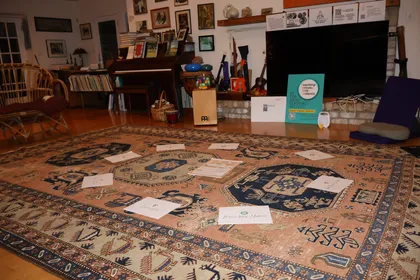
Following TAMA’s inaugural Teaching Artist Retreat, I keep returning to a refrain I heard repeatedly from Teaching Artists: “I thought it was just me.”
We collaborate artistically, but structurally, we are left competing for too little work, too little pay, too little visibility, and too little long-term stability.
But at TAMA’s inaugural retreat, there was possibility.
The possibility that Teaching Artists may have far more collective power than we have been encouraged to recognize.
# I thought it was just me.
After the retreat, my brother shared a major labor victory for hotel housekeepers in New York City), who secured historic wage increases and labor protections.
Last Monday, I shared the article at dinner during TAMA’s fundraiser at Franklin’s Restaurant, Brewery, and General Store. Several people at the table were shocked by the wage increases and immediately asked, “But where is the hotel getting the money to pay the workers?”
Management finds the money when labor becomes organized enough to be valued differently. After years of reviewing nonprofit 990s, experiencing institutional growth, and negotiating contracts differently myself, I believe the same dynamic shapes Teaching Artists. What we lack is organized labor power, shared standards, collective leverage, and coordinated visibility.
But I pause when people say to me, “TAMA should become a union.”
Unions do not emerge overnight or from volunteer boards alone. They are built through workers recognizing themselves as workers and choosing to move together despite the risks, fears, and fragmentation intentionally embedded within labor systems.
My brother, who works for the Hotel and Gaming Trades Council (HTC), has explained that unions typically do not file for an election as soon as workers express interest in organizing. Legally, workers need only a threshold of support to trigger an election process, but most unions aim to build much stronger support—often around 75 percent—before filing. They do so because once an organizing effort becomes public, management will launch an aggressive anti-union campaign designed to weaken solidarity and create doubt among workers. Organizers understand that support can erode under that pressure.
Why? Because management will often isolate individuals, elevate divisions, and challenge emerging solidarity as soon as it begins to form. Fragmentation is one of the oldest tools of labor control.
# Institutional leadership often recognizes the potential leverage of coordinated Teaching Artist action long before Teaching Artists recognize their own capacity for collective action
I’ve been on the administrative side of arts organizations when a Board expressed concern about Teaching Artists organizing. The Teaching Artists were not organizing. But this is not about one organization. Institutional leadership often recognizes the potential leverage of coordinated Teaching Artist action long before Teaching Artists recognize their own capacity for collective action. It is a dynamic embedded within broader systems shaping all of us.
Dr. Quanice Floyd, writing through the Pete Flo Enterprises substack, reflected on imagining futures where “domination itself is no longer the organizing principle.” I share her diagnosis of the systems shaping the arts sector and deeply appreciate the nine dynamics she names. I stand with her in the work of building liberation.
Because what strikes me about the hotel workers’ win is the infrastructure behind it: organization, shared investment, collective strategy, and sustained worker solidarity. TA Café attendees have heard me speak about the Montgomery Bus Boycott as a model for this kind of collective power. An entire community refused to participate in an unjust system. For months, people coordinated rides, walked long distances, pooled resources, and made sustained sacrifices because they understood that injustice required collective action and infrastructure for resistance.
To arts sector administrators and institutional leaders: you can actively support Teaching Artists in achieving positive outcomes that extend beyond your organizations' walls. Currently, artists experience the power structures, where future opportunities quietly depend upon silence, compliance, and non-disruption.
To my fellow Teaching Artists: we speak passionately about justice, equity, belonging, creativity, healing, and transformation, but are we equally prepared to build and sustain collective structures for ourselves?
The retreat did not have a solution. But the possibility of what if Teaching Artists stopped thinking of ourselves as isolated freelancers and began to recognize that some of our energy must be intentionally invested in the coordinated development of our profession.
# Solidarity is not simply agreement. It is workers choosing to participate even when exhausted, underpaid, overextended, and fragmented.
Solidarity is not simply agreement. It is workers choosing to participate even when exhausted, underpaid, overextended, and fragmented.
# At the very moment when solidarity is most necessary, the institutions that shape our field succeed in re-fragmenting us.
I’ve referenced before my colleague Devin Walker (aka Uncle Devin Show), and his P.S.A. framework for organizing: Problem. Solution. Action. Teaching Artists can name the pressures, inequities, and contradictions they experience. Many artists can imagine solutions.
But sustained collective action is where we struggle. At the very moment when solidarity is most necessary, the institutions that shape our field succeed in re-fragmenting us.
How do we move from understanding problems and imagining solutions into collective action in the long, difficult work of building collective liberation?