
# Divide and Conquer, Part 2: The Infrastructure Problem in Teaching Artistry
If we’re serious about fair pay, we have to be serious about systems.
Last week's Divide and Conquer piece has become part 1. There, I explored how Teaching Artists are fragmented across the field. Here, I move us from fragments to infrastructure.
Fragmentation shows up in how Teaching Artists are trained, paid, contracted, classified, and positioned across systems that rarely intersect in consistent or equitable ways.
Rates don’t fix instability.
Training doesn’t grant power.
Systems do.
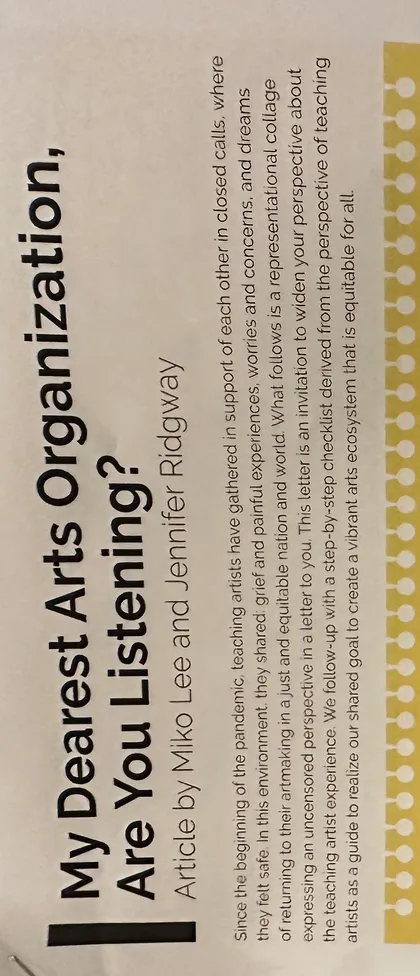
In 2021, Miko Lee and I co-authored a piece titled “My Dearest Arts Organization: Are You Listening?” It included a clear checklist for change.
Years later, I am still waiting to see those steps taken.
Listening matters. It requires action.
# Fair Pay is Not a Rate Issue
Frequently, artists and organizations ask:
- What is the going rate?
- What should we pay per workshop?
- How do we stay competitive?
These questions make Teaching Artist labor less visible, not more accountable. I outlined invisibility in The Hidden Labor of Teaching Artists.
Before we talk about rates, organizations must ask a more fundamental question: What is the job description that reflects the full scope of the work?
Too often, job descriptions are incomplete or altogether missing.
Without a job description that recognizes the hidden labor, organizations can not actually set meaningful rates. They only approximate compensation based on their incomplete picture of the requirements. As a result, it becomes difficult, if not impossible, to consistently hire, support, or evaluate qualified professionals.
This is where “training” is often introduced as a substitute for institutional clarity. This places artists in situations where they effectively provide unpaid labor under the guise of preparation. Over the weekend, I spoke to an artist with four decades of experience and several certifications who recently completed Teaching Artist training to be hired.
This is a structural failure.
# Teaching Artists Are Small Businesses
Most Teaching Artists are not simply practitioners. They are independent vendors managing:
- multiple contracts
- inconsistent income streams
- self-employment taxes
- insurance (if accessible)
- retirement planning
- marketing, outreach, and relationship-building
These are functions of small businesses. A certified public accountant (like my father) will tell you that if you file a Schedule C on your personal taxes, the federal government already recognizes you as a business.
Yet many artists hesitate to claim that identity. I hear artists say:
- “I don’t want to be a business.”
- “Organizations don’t hire you as a business.”
- “I can’t get a grant as a business.”
Organizations are not designed to support artists as they shift into this identity. Frankly, it is easier and more cost-effective to continue exploiting Teaching Artists as flexible labor rather than as professional partners with sustained practices. Advocacy at the state level can make positive shifts. We have seen this in Maryland.
Within TAMA, artists support each other in forming LLCs, building partnerships, securing insurance, and investing in professional readiness, while also advocating for systems that enable their businesses to access funding and contract opportunities directly.
In other parts of the arts ecosystem, partnership standards serve as a model. For example, theatres partner with playwrights to bring new work to the stage. The organization does not require playwright training for a commissioned play or require that the playwright transfer ownership to the theatre. The relationship is structured as professional collaboration and creative development.
Structures of a similar nature can and should support Teaching Artist practices.
In my own work, I partner with a library at a local farmers market, working predominantly with Spanish-speaking families, opening doors for these shoppers to experience theatre while encouraging their use of the community library. I created it in collaboration with the library, applying my artistic practice. This kind of embedded, community-based work requires professional autonomy and expands access to relationships and funding in ways institutions alone cannot achieve.
# Contracts Are Part of Compensation
Pay is not just about how much. Short-term, project-based contracts create instability even when rates are strong. Teaching Artists are frequently asked to:
- confirm availability with little notice
- absorb last-minute cancellations
- bridge gaps between contracts
- rebuild schedules each season
This makes long-term planning nearly impossible.
Fair pay requires:
- clear, transparent contracts
- reasonable timelines, including paid holding time where relevant
- cancellation protections
- longer-term engagements where possible
Because stability is part of compensation. I’m grateful for models like Arts Every Day in Baltimore, where artists set their own rates and are paid quickly upon invoicing, sometimes months before delivery.
A common concern is trust. But when professionals are treated with respect, accountability increases.
Trust is not something systems lose when artists are empowered. It is something they gain. Where and how artists are empowered matters. Too often, I see new opportunities that reinforce existing divide-and-conquer systems.
# Benefits Require Investment
In most professions, benefits such as health insurance, retirement contributions, paid leave, and unemployment benefits are standard. Teaching Artists carry these costs individually as they navigate multiple contracts and organizations. Emerging models with cooperative employment and portable benefits reinforce that Teaching Artists are mobile and require mobile benefits.
Organizations like Teaching Artists of the Mid-Atlantic (TAMA) could build benefit packages similar to those of other unions or membership-based professions.
But that requires investment.
Without support from artists, organizations, agencies, and funders, TAMA, or organizations like TAMA, cannot build the systems needed to scale this work. The divide-and-conquer structure of the field makes that opportunity nearly impossible.
# Accountability Matters
For years, I have advocated for the use of visionary tools like the Teaching Artists Guild’s pay rate calculator. I observed organizations endorse this tool while continuing to underpay. Funders also supported the tool, but failed to hold organizations accountable to the rates. Tools require enforcement structures to create meaningful shifts.
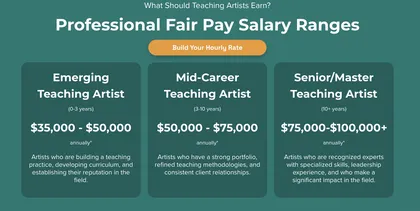
Earlier this year, TAMA published regional salary ranges and a rate builder aligned with cost-of-living and industry standards for the Mid-Atlantic. Contributing members will annually vote to ensure ongoing alignment. The next step is accountability.
Accountability requires commitment from all stakeholders.
# A Hidden Layer: Silence and Control
The arts sector often frames compensation as a funding problem. Yes, and… scarcity is also a narrative choice in how the field is structured and justified. To stay competitive, organizations promote: “Art is free for every student.”
When it is framed that way, it is often subsidized by Teaching Artists.
Many Teaching Artists understand this truth and risk future work when they say it out loud.
There are too many job boards promoting inequitable opportunities. When I raise an issue with posts, I'm told there is no standard. I've recommended TAMA's principles and other tools. Frequently, I'm told TAMA doesn't have the infrastructure. A silly accusation.
Interestingly, Teaching Artist contracts include clauses that limit discussion of pay, working conditions, or grievances. When artists do speak up, they may be let go quietly, or simply not rehired or given work in subsequent seasons.
These contradictions exist everywhere in a field that claims equity.
Equity cannot exist without transparency, accountability, and enforceable structures.
# Support for Teaching Artist Practice
When Teaching Artists are recognized as a business with artistic practice:
- they remain in the field longer
- their practice deepens
- relationships with communities strengthen
- programs become more consistent
- knowledge is retained instead of constantly rebuilt
For example, the program I run at a local farmers market has continued for four years with predominantly Spanish-speaking families. Students return each year, building on prior learning and contributing lived experience back into the work. That continuity exists because of long-term relationships rooted in community practice that I bring. It is not transactional placement. And I am part of that continuity.
With each cycle, my practice deepens as well. In my aging-in-place storytelling work, I’ve seen how professional development in safety, care, and preparedness becomes integrated into artistic responsibility. These are not add-ons. They are part of a lifelong, evolving practice.
When we take this view, teaching artistry is no longer a series of gigs or isolated programs.
It is an artistic practice that requires integrity, continuity, and sustainability.
That shift requires stakeholders to ask:
- Are we compensating the full scope of labor?
- Are we building conditions for long-term sustainability?
- Are we designing systems that support professionals with businesses?
Until these questions are addressed, we will continue to rely on and exploit the flexibility of the Teaching Artist workforce, and fair pay will remain something we discuss rather than something we practice.
# What Comes Next
A way to put it into practice.
# A Simple Check for Organizations and Funders
- Is there a complete job description that reflects the full scope of Teaching Artist labor?
- Are budgets built from stated values, with full labor costs visible and funded from the outset?
- Is compensation calculated from the full scope of labor described?
- Are contracts structured for stability with clear outlines of expectations, notice periods, cancellation protections, and paid holding time where applicable?
- Are Teaching Artists meaningfully included in compensation design, program structure, and decision-making about their own work?
- Are administrators and institutions actively supporting Teaching Artist-led organizations and infrastructures that sustain the practice and business of teaching artistry they need?
- Are benefits addressed in a way that reflects the reality of a mobile, contract-based workforce?
- Is there transparency and enforceability in pay structures, including accountability when stated rates are not honored in practice?
If the answer is no to any of these, the issue isn’t the rate, training, or listening. It’s the system.
Read More
Who Gets to Define Teaching Artistry?
Building on Beyond Membership, this essay asks what collective power looks like in practice. It argues that professional infrastructure from pay tools to standards and governance should be created with, governed by, and accountable to Teaching Artists. TAMA's Fair Pay Rate Builder is presented not simply as a calculator, but as one step toward Teaching Artists defining and governing their own profession.
Beyond Membership
Building from Divide and Conquer: Why Teaching Artists Struggle to Mobilize Collectively, this essay explores what comes after recognizing fragmentation: building power. Through reflections on membership, labor organizing, and Teaching Artist-led infrastructure, it examines why connection alone is not enough to change systems. The work ahead is not creating new knowledge—it is creating the structures, resources, and shared power needed to act on what Teaching Artists already know.
Divide and Conquer: Why Teaching Artists Struggle to Mobilize Collectively
The field shapes Teaching Artists through structural fragmentation across geography, disciplines, employment systems, and institutional access. These overlapping systems produce uneven value, scarcity, and separation between “inside” and “outside” positions, limiting connection and hindering collective organizing. With collective commitment, Teaching Artists can move from fragmentation toward power.

The Hidden Labor of Teaching Artists
This piece exposes the full scope of Teaching Artist labor. Before, between, during, and after the visible moment of a session, and how most of it goes uncompensated. This invisibility is not accidental, but structural, with artists absorbing the cost of sustaining programs. The result is a system that depends on hidden labor while failing to fully recognize or resource the professionals doing the work.
Stop Training Teaching Artists. Start Paying Them.
Teaching Artists are often told the solution is more training. We are missing the real issues: a lack of compensation, trust, and power-sharing with artists. Teaching Artists know what the work demands, and when they have felt valued and supported in doing their best work.

Outside the Gate: A Story About Excellence in Teaching Artistry
This personal reflection traces my journey as a Teaching Artist working outside what is traditionally considered “respected” theatre. It asks a central question: if the work has always been excellent, why have our systems struggled to recognize, resource, and value it?
We Don’t Have a Training Problem. We Have a Pay Problem.
This follow-up builds on the growing conversation sparked by my recent post. It clarifies what’s at stake for Teaching Artists and lays the groundwork for a series of deeper explorations into fair pay, hidden labor, systemic barriers, and what it will take to move from dialogue to action.

Stop Rebuilding What Already Exists: Teaching Artists Are Leading the Field
The Teaching Artist field does not need to be rebuilt. It needs to be recognized and resourced. This piece exposes the cycle of extractive “listening,” highlights the work already being led by Teaching Artists, and calls for a shift in power, compensation, and accountability.