
# Outside the Gate: A Story About Excellence in Teaching Artistry
What if the problem has never been the quality of the work? What if the problem is what we’ve been willing to recognize as “real” art - theatre, music, dance, visual art - or just art?
I’ve spent my career working outside what is traditionally considered “respected.” It's where I'm comfortable, pushing at the edges of what counts as respected, professional, and excellent art-making.
I never left excellence.
In college at the University of Maryland, College Park (‘96), I received an Irene Ryan nomination while earning a degree in performance. In my final semester, I made a nontraditional decision. I took a course outside the theatre department and landed an internship with Kaiser Permanente’s Educational Theatre Programs (ETP). That internship became everything to my career. However, I got the distinct sense from others' feedback that my decision was unwise.
Educational and youth theatre wasn’t “respected.” Even today, it faces challenges. But as I neared graduation, ETP directors Scot Fortune and Ed Eaton auditioned me for one of their touring ensembles. I walked out of college and directly into a professional career. ETP gave me a five-day-a-week performance schedule, a full-time income, and health insurance; not to mention, I was doing rewarding work, and work that I was passionate about. It was an excellent start to a lifelong career. Professional, rigorous, and sustaining.
When I moved on from ETP and began navigating the broader DMV theatre scene. I landed gigs, including with Adventure Theatre and Imagination Stage. I was excelling onstage and through my teaching artistry. I also continued to build my craft and pursue excellence in my performance and teaching, and was invited to participate in sessions at the Kennedy Center, where I worked with Barbara Cook and Marnie Nixon.
After one very public session with Barbara Cook, my voice teacher told me, “You need to make a decision.” The message was clear: Focus on “adult” theatre if I wanted to be taken seriously. My passion, however, was youth theatre, educational theatre, and teaching artistry. Didn't this work require excellence?
I reached a point where I needed to increase my income to have a sustaining, thriving life. At the time, I thought an MFA program was the answer. I enrolled in the Theatre for Young People program at the University of North Carolina at Greensboro. It was a smaller program, but one where I could act, direct, and teach, both in the community and at the university, and more. That breadth of experience mattered deeply to me. It was the life I wanted. My time there began onstage as Gertrude in Seussical. My performance drew the department's attention. A professor suggested I leave the youth theatre track and join the acting program where I belonged.
I've appreciated being encouraged and recognized throughout my career. I've consistently received love and a shower of compliments, but I question the underlying message: that excellence in educational, youth, and community-based theatre was somehow lesser, or less worthy of recognition, or altogether not required.
These days, I’m back in the DMV area, and Adventure Theatre and Imagination Stage are now receiving Helen Hayes nominations and awards. I’m proud of the artists, the theatres, and the field for expanding its scope of excellence.
Now my work happens outside of venues, in communities. And I find myself asking: Is this work not excellent? Can it be truly valued?
Whether in classrooms, community centers, parks, hospitals, or wherever I am, my participants demonstrate excellence with each encounter. And I know the excellence I bring into our shared experiences. Through my presence, practice, and care, I create the conditions for their excellence to emerge, be applied, and fully shine. I believe deeply in the work we do together.
This story is still unfolding, and you are part of my next chapter. I’m asking the world to meet me where I am now. How do we choose to see professional Teaching Artists? And their participants in our communities?
I see excellence. Rigor. Creativity. Artist impact.
What would it take for that excellence to be recognized, resourced, and respected more broadly?
We’ve got work to do.
It starts this Tuesday when I begin to share more deeply about the experience I've walked as an artist, Teaching Artist, arts administrator, arts advocate, and co-Founder/President of Teaching Artists of the Mid-Atlantic.
I’m sharing this now because it sits at the root of everything to come. If we are going to talk about Teaching Artists, we have to start with what we already know: the work is excellent. The question is whether our systems are willing to see it.
Read More
Who Gets to Define Teaching Artistry?
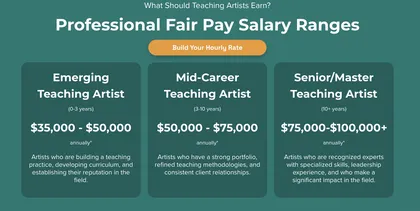
Building on Beyond Membership, this essay asks what collective power looks like in practice. It argues that professional infrastructure from pay tools to standards and governance should be created with, governed by, and accountable to Teaching Artists. TAMA's Fair Pay Rate Builder is presented not simply as a calculator, but as one step toward Teaching Artists defining and governing their own profession.
Beyond Membership
Building from Divide and Conquer: Why Teaching Artists Struggle to Mobilize Collectively, this essay explores what comes after recognizing fragmentation: building power. Through reflections on membership, labor organizing, and Teaching Artist-led infrastructure, it examines why connection alone is not enough to change systems. The work ahead is not creating new knowledge—it is creating the structures, resources, and shared power needed to act on what Teaching Artists already know.

Divide and Conquer, Part 2
In part 2, I further examine how fragmentation in Teaching Artistry is built into systems of pay, contracting, classification, and training. I argue that this requires structural clarity, shared standards, and enforceable systems that reflect the full scope of Teaching Artist labor.
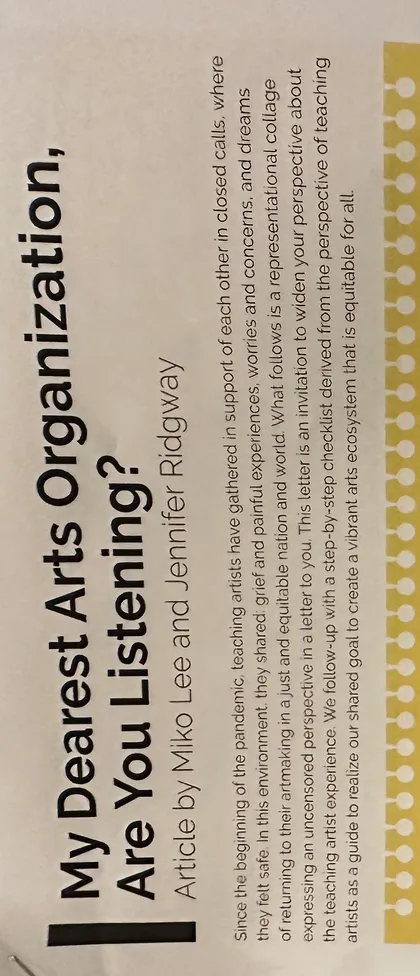
Divide and Conquer: Why Teaching Artists Struggle to Mobilize Collectively
The field shapes Teaching Artists through structural fragmentation across geography, disciplines, employment systems, and institutional access. These overlapping systems produce uneven value, scarcity, and separation between “inside” and “outside” positions, limiting connection and hindering collective organizing. With collective commitment, Teaching Artists can move from fragmentation toward power.

The Hidden Labor of Teaching Artists
This piece exposes the full scope of Teaching Artist labor. Before, between, during, and after the visible moment of a session, and how most of it goes uncompensated. This invisibility is not accidental, but structural, with artists absorbing the cost of sustaining programs. The result is a system that depends on hidden labor while failing to fully recognize or resource the professionals doing the work.
Stop Training Teaching Artists. Start Paying Them.
Teaching Artists are often told the solution is more training. We are missing the real issues: a lack of compensation, trust, and power-sharing with artists. Teaching Artists know what the work demands, and when they have felt valued and supported in doing their best work.
We Don’t Have a Training Problem. We Have a Pay Problem.
This follow-up builds on the growing conversation sparked by my recent post. It clarifies what’s at stake for Teaching Artists and lays the groundwork for a series of deeper explorations into fair pay, hidden labor, systemic barriers, and what it will take to move from dialogue to action.
Stop Rebuilding What Already Exists: Teaching Artists Are Leading the Field
The Teaching Artist field does not need to be rebuilt. It needs to be recognized and resourced. This piece exposes the cycle of extractive “listening,” highlights the work already being led by Teaching Artists, and calls for a shift in power, compensation, and accountability.