
# We Don’t Have a Training Problem. We Have a Pay Problem.
About the feedback following my recent post:
It’s clear: there is no shortage of insight in the Teaching Artist field.
What we are experiencing is not a lack of ideas. It’s a lack of alignment, investment, and follow-through on what already exists.
That distinction matters.
Because when the conversation keeps circling back to:
→ new programs
→ new frameworks
→ new training pathways
Without resourcing the work that Teaching Artists have already built and continue to build, we risk perpetuating the very cycle many of us are naming and losing highly skilled, professional Teaching Artists. In some cases, we are also seeing existing work reabsorbed, renamed, or redistributed without clear accountability to the Teaching Artists who built it.
I am one of those Teaching Artists who has been building, and I want to share what I’m building toward next.
This isn’t just one post. I’m digging deeper into my work, and into the structures shaping our field.
Some of the posts I’m currently developing include:
- “We Do Not Have a Training Problem”
A deeper look at why certification and degree programs are not the solution—and what is. - “The Hidden Labor of Teaching Artists”
What goes unseen: planning, travel, emotional labor, safety, and why current pay structures ignore it. - “Divide and Conquer: How the Field Stays Fragmented”
A candid look at how power dynamics—intentional or not—prevent Teaching Artists from mobilizing. - “What Fair Pay Actually Requires”
Moving beyond rates into systems: contracts, benefits, and accountability. - “Stop Asking Us to Start Over”
On institutional cycles of “listening” and why they so often fail to produce change.
I am not interested in restarting conversations that Teaching Artists have already had.
As a leader, I have been asked—time and again—to engage in one-to-one conversations, write articles, participate on panels, and speak on podcasts. Too often, those spaces require tiptoeing around harder truths, resulting in a lack of follow-up and minimal progress, and ultimately extending timelines, while Teaching Artist-led organizations like Teaching Artists of the Mid-Atlantic (TAMA) continue doing the work. For the last five years, I’ve been reflecting on what that work has actually produced, and what it hasn’t.
I am ready to support more direct and broader conversations.
Conversations about power, compensation, contracts, and the lived realities Teaching Artists navigate inside systems that were not built for our sustainability.
I’ve sat in rooms as both an artist and an administrator. I’ve seen how decisions are made, how language is used, and how structures are justified.
I also led the writing of TAMA’s recommendation to the U.S. Department of Labor to add “Teaching Artist” to the Standard Occupational Classification (SOC) system. While our request now sits in limbo under the current administration, the work itself revealed a great deal about how this field operates.
Through all of this, I’ve held conversations with my dad, a Certified Public Accountant, and my brother, a union leader, expanding my understanding of my experience of this occupation and field.
All of this will be part of what I share moving forward.
I am interested in moving us toward action.
If you are in this field—artist, administrator, funder, or policymaker—you have a role in that shift.
If there are specific questions or realities you’re seeing that you want named, I want to hear them. I’m a big fan of Devin Walker’s P.S.A. Approach to Organizing (Problem. Solution. Action.), which TAMA has incorporated into its principles for professional Teaching Artists.
More soon. I’m listening closely to what needs to be named next and working to bring more of this conversation forward ahead of and during National Teaching Artist Month (May). That will be a moment to move beyond dialogue and into direct support of Teaching Artist-led organizations.
Read More
Who Gets to Define Teaching Artistry?
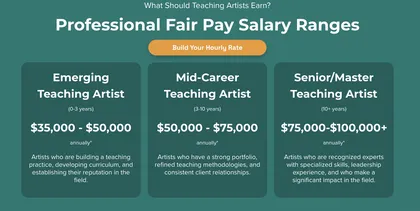
Building on Beyond Membership, this essay asks what collective power looks like in practice. It argues that professional infrastructure from pay tools to standards and governance should be created with, governed by, and accountable to Teaching Artists. TAMA's Fair Pay Rate Builder is presented not simply as a calculator, but as one step toward Teaching Artists defining and governing their own profession.
Beyond Membership
Building from Divide and Conquer: Why Teaching Artists Struggle to Mobilize Collectively, this essay explores what comes after recognizing fragmentation: building power. Through reflections on membership, labor organizing, and Teaching Artist-led infrastructure, it examines why connection alone is not enough to change systems. The work ahead is not creating new knowledge—it is creating the structures, resources, and shared power needed to act on what Teaching Artists already know.

Divide and Conquer, Part 2
In part 2, I further examine how fragmentation in Teaching Artistry is built into systems of pay, contracting, classification, and training. I argue that this requires structural clarity, shared standards, and enforceable systems that reflect the full scope of Teaching Artist labor.
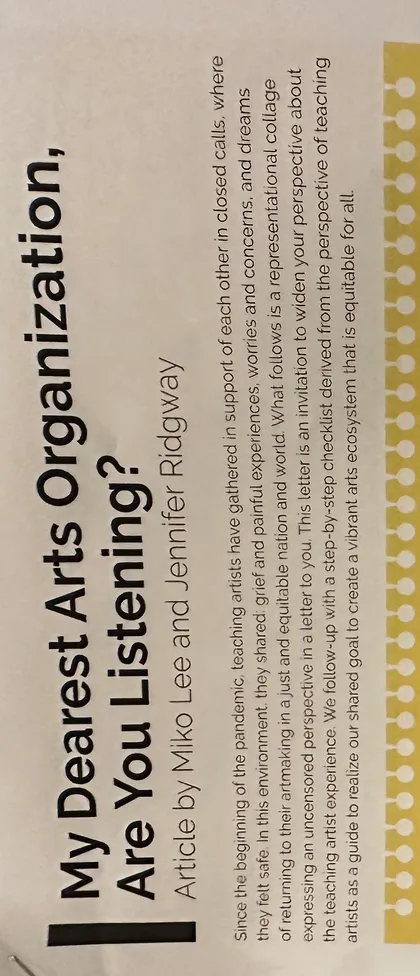
Divide and Conquer: Why Teaching Artists Struggle to Mobilize Collectively
The field shapes Teaching Artists through structural fragmentation across geography, disciplines, employment systems, and institutional access. These overlapping systems produce uneven value, scarcity, and separation between “inside” and “outside” positions, limiting connection and hindering collective organizing. With collective commitment, Teaching Artists can move from fragmentation toward power.

The Hidden Labor of Teaching Artists
This piece exposes the full scope of Teaching Artist labor. Before, between, during, and after the visible moment of a session, and how most of it goes uncompensated. This invisibility is not accidental, but structural, with artists absorbing the cost of sustaining programs. The result is a system that depends on hidden labor while failing to fully recognize or resource the professionals doing the work.
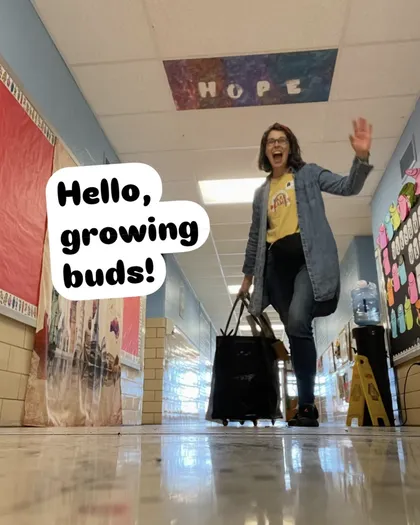
Stop Training Teaching Artists. Start Paying Them.
Teaching Artists are often told the solution is more training. We are missing the real issues: a lack of compensation, trust, and power-sharing with artists. Teaching Artists know what the work demands, and when they have felt valued and supported in doing their best work.

Outside the Gate: A Story About Excellence in Teaching Artistry
This personal reflection traces my journey as a Teaching Artist working outside what is traditionally considered “respected” theatre. It asks a central question: if the work has always been excellent, why have our systems struggled to recognize, resource, and value it?

Stop Rebuilding What Already Exists: Teaching Artists Are Leading the Field
The Teaching Artist field does not need to be rebuilt. It needs to be recognized and resourced. This piece exposes the cycle of extractive “listening,” highlights the work already being led by Teaching Artists, and calls for a shift in power, compensation, and accountability.