# Stop Training Teaching Artists. Start Paying Them.
# We Don’t Have a Training Problem. We Have a Compensation—and Power—Problem.
And yet, when the field claims to listen to Teaching Artists, the answer is always the same: Training.
Why?
Teaching Artists are not undertrained. They come to this work with:
- Degrees and conservatory training
- Years of artistic practice
- Experience across classrooms, community spaces, and institutions
- Ongoing professional development, mentorship, and peer learning
They develop their practice in real environments, with real communities, making real decisions.
That kind of learning does not happen through one-time trainings or organizational onboarding. It happens over time—through observation, collaboration, reflection, and iteration.
# What We Call “Training” Isn’t Development
What organizations often call “Teaching Artist training” is, in reality, onboarding.
Training Teaching Artists to deliver a fixed program is not professional development. It is onboarding. More importantly, it doesn’t honor their existing expertise. And, it rarely equips them to make nuanced decisions in complex, real-world learning environments beyond the confines of a single program or institution. Sometimes, it doesn't even give them that.
When Teaching Artists are not empowered to assess risk and adapt responsibly, harm can occur—for themselves, their participants, and their communities.
I have seen unsafe practices encouraged in the name of training.
I have seen artists placed in situations they were not prepared to navigate.
These are not failures of individual artists.
They are failures of systems that prioritize control over expertise.
# Artists Are Trapped In the Training Cycle
In 2006, I had a strong career in the DMV. But my income wasn’t growing.
So I did what many artists do:
I earned an MFA in Theatre for Young People. The training was rigorous, expansive, and deeply meaningful.
I returned in 2009 ready to move forward.
Nothing changed.
The rates were the same. The expectations were the same. I was even asked to repeat Teaching Artist “training” at organizations that had already hired me years earlier.
I brought more experience—and student debt—back into the same system.
If I worked more, I could make more. Program demands left little time.
# What This Work Actually Demands
Teaching Artist practice is not confined to what happens during a session.
Their artistry shows up in how they:
- Assess environments
- Anticipate risk
- Adapt in real time
- Understand the full arc of an experience beyond a single interaction
When that full arc isn’t considered with time for thoughtful care, the consequences can be serious—physical and emotional—extending beyond the workshop itself.
And yet, artists are routinely placed in unfamiliar contexts and expected to “figure it out,” as they hurry on to the next gig.
I can already hear the response: That’s a training gap.
It’s not.
It’s a power and responsibility gap.
Teaching Artists are rarely given the authority to shape the conditions of their work, only the responsibility to carry it out. They are expected to manage complexity without the compensation, trust, or decision-making power required to do so well.
That mismatch is where risk lives.
# What Trust Looks Like
In my work with Arts Every Day, artists are not assigned to a classroom or even a school and are expected to “make it work.” They are trusted to determine fit from the outset.
When a school expresses interest in me, I receive a notification and connect directly with the contact for what I've named a discovery call. On the call, I assess alignment:
- Am I the right artist for this work?
- Do I have the right skills?
- Do I have the capacity to do this well?
- Can I craft a program, or is one in my portfolio, to meet needs?
- Do I have the time to plan and implement with quality?
- Or is another artist a better fit?
This structure returns responsibility and expertise to where they belong: with the artist.
That is what professional respect looks like.
More importantly, it reflects what real professional development can be: ongoing, applied, and responsive. In those conversations, I am not only assessing my current fit. I am also reflecting on the future of my practice. Where do I want to grow? What work energizes me? What niche am I developing over time? These conversations open doors for how I think about my work.
That is what development actually looks like. It is not a one-time training. It is iterative, relational, and embedded in real practice.
Ultimately, real growth often happens outside formal structures.
These reflections with myself have led me to a puppetry conference. When I began working with elders, I pursued first aid training and made it standard practice to locate the nearest defibrillator before each session. In my environmental work, I became a Master Naturalist and am currently training as a Master Gardener.
That is the work.
This is my artist's homework.
Not compliance. Not repetition. Responsibility.
For my practice.
My business.
My participants.
My clients.
My partners.
# When Systems Don’t Trust Artists
I’ve also experienced what happens when trust is absent.
When I returned to Maryland in 2015, I sought to join the state Teaching Artist roster. Despite years of experience, I was advised to complete an external Teaching Artist training program in order to be placed.
Not experience.
Not leadership.
Training.
I did what artists do: I complied.
What I found was not development. It was structure without recognition or trust.
I contributed unpaid labor. At times, I was also advising other participants who were earlier in their careers. I was not being developed. I was being used to validate a system that did not recognize my expertise.
I withdrew.
Members of Teaching Artists of the Mid-Atlantic advocated for and supported revisions to the Maryland State Arts Council's Arts In Education program, which launched in May 2020. There is still more work to do in Maryland and beyond.
That moment clarified something I could no longer ignore.
When experienced Teaching Artists are repeatedly asked to re-prove their value without corresponding compensation, authority, or stability, we are not building pathways.
We are reinforcing barriers.
# The Risk of Getting This Wrong
When we prioritize credentialing over compensation, we:
- Deepen inequity by creating financial and structural barriers
- Exclude artists whose expertise is rooted in lived experience, culture, and community
- Lose experienced Teaching Artists who cannot afford to stay
- Train artists for work that cannot sustain them
Stop wondering why the field is struggling.
# The Real Question
This is not a question of training.
It is a question of whether we are willing to:
- Compensate Teaching Artists for the full scope of their labor
- Build systems that support long-term, sustainable careers (I do not mean full-time employment at an organization.)
- Shift power so Teaching Artists help shape the structures that govern their work
Because until we do, more training will not solve the problem.
It will only ask more of the people already carrying the field.
# What Comes Next
There are real tensions in this field between those working inside systems and those outside of them. I have been both.
These tensions are structural, lived, and often uncomfortable. We need to stop avoiding them.
Because Teaching Artists already know what the problem is.
It is not training.
It is compensation.
It is power.
It is value.
The question is whether we are ready to address that, honestly, and together.
Read More
Who Gets to Define Teaching Artistry?
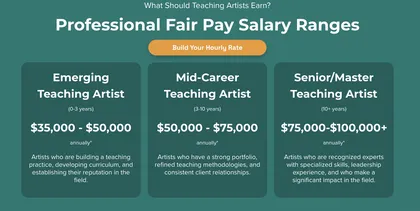
Building on Beyond Membership, this essay asks what collective power looks like in practice. It argues that professional infrastructure from pay tools to standards and governance should be created with, governed by, and accountable to Teaching Artists. TAMA's Fair Pay Rate Builder is presented not simply as a calculator, but as one step toward Teaching Artists defining and governing their own profession.
Beyond Membership
Building from Divide and Conquer: Why Teaching Artists Struggle to Mobilize Collectively, this essay explores what comes after recognizing fragmentation: building power. Through reflections on membership, labor organizing, and Teaching Artist-led infrastructure, it examines why connection alone is not enough to change systems. The work ahead is not creating new knowledge—it is creating the structures, resources, and shared power needed to act on what Teaching Artists already know.
Divide and Conquer, Part 2
In part 2, I further examine how fragmentation in Teaching Artistry is built into systems of pay, contracting, classification, and training. I argue that this requires structural clarity, shared standards, and enforceable systems that reflect the full scope of Teaching Artist labor.
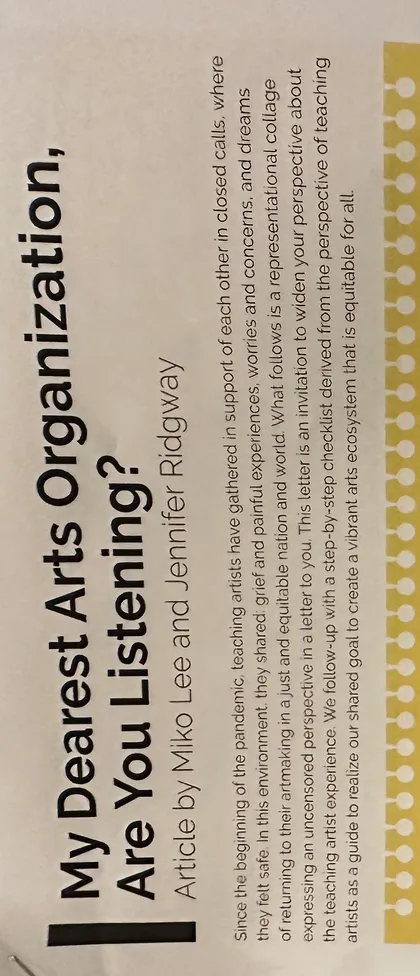
Divide and Conquer: Why Teaching Artists Struggle to Mobilize Collectively
The field shapes Teaching Artists through structural fragmentation across geography, disciplines, employment systems, and institutional access. These overlapping systems produce uneven value, scarcity, and separation between “inside” and “outside” positions, limiting connection and hindering collective organizing. With collective commitment, Teaching Artists can move from fragmentation toward power.

The Hidden Labor of Teaching Artists
This piece exposes the full scope of Teaching Artist labor. Before, between, during, and after the visible moment of a session, and how most of it goes uncompensated. This invisibility is not accidental, but structural, with artists absorbing the cost of sustaining programs. The result is a system that depends on hidden labor while failing to fully recognize or resource the professionals doing the work.

Outside the Gate: A Story About Excellence in Teaching Artistry
This personal reflection traces my journey as a Teaching Artist working outside what is traditionally considered “respected” theatre. It asks a central question: if the work has always been excellent, why have our systems struggled to recognize, resource, and value it?

We Don’t Have a Training Problem. We Have a Pay Problem.
This follow-up builds on the growing conversation sparked by my recent post. It clarifies what’s at stake for Teaching Artists and lays the groundwork for a series of deeper explorations into fair pay, hidden labor, systemic barriers, and what it will take to move from dialogue to action.
Stop Rebuilding What Already Exists: Teaching Artists Are Leading the Field
The Teaching Artist field does not need to be rebuilt. It needs to be recognized and resourced. This piece exposes the cycle of extractive “listening,” highlights the work already being led by Teaching Artists, and calls for a shift in power, compensation, and accountability.