# Who Gets to Define Teaching Artistry?
Professional Self-Governance Begins with Infrastructure
Last week I argued that Teaching Artists need more than membership. We need collective power. Membership creates connection. Collective infrastructure creates influence.
What is collective infrastructure?
For me, it's Teaching Artists governing the tools, trainings, and standards that define our profession. For decades, organizations have led that work.
Some of the tools in that work have been enormously valuable.
The Teaching Artists Guild's pay calculator was one of the most important tools our field has produced. It opened conversations about compensation that many organizations had avoided for years. I promoted it enthusiastically. Teaching Artists of the Mid-Atlantic (TAMA) originally grounded its Professional Teaching Artist Principles in its use because it was the strongest public commitment to fair pay available to Teaching Artists at that time.
But to be frank, I experienced organizations claiming their rates aligned with the calculator when, in practice, they did not. That disconnect made me realize something important: a tool can start a conversation, but it cannot govern an equitable and sustainable professional practice.
# A tool can start a conversation, but it cannot govern an equitable and sustainable professional practice.
It forced me to examine the governance structures behind these conversations. Leadership in many of our organizations includes people who move between artist and administrator roles. I know because I once held that dual role myself. I was the person my organization paid to attend conferences, serve on national committees, and bring new ideas back to the independent Teaching Artists we contracted.
That perspective was valuable, but it also revealed something I couldn't fully see at the time. Even with the best intentions, there is an inherent structural tension when the same people are responsible for advocating for Teaching Artists while also managing organizational budgets. Those are not simply different perspectives but competing responsibilities. That tension doesn't make anyone the problem. It does shape the conversations, the priorities, and ultimately the profession.
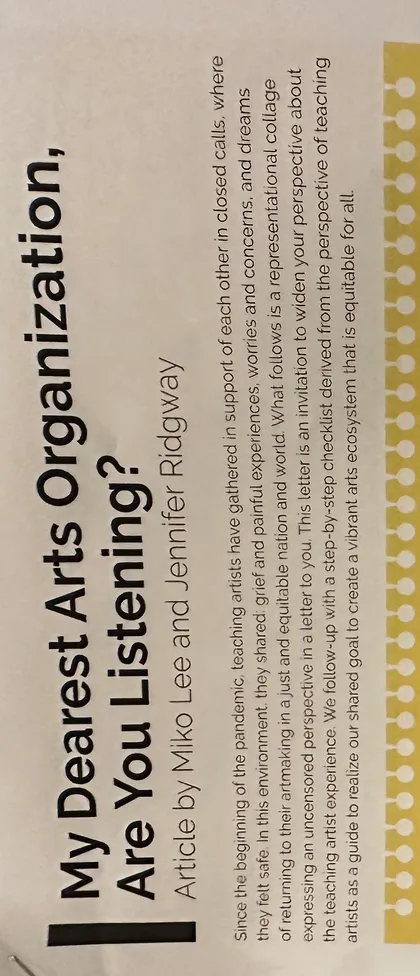
In My Dearest Arts Organization, Are You Listening?, Miko Lee and I recommended that organizations should bring Teaching Artists into decision-making by adding them to boards, compensating them for their expertise, and including them in program development and assessment.
Representation matters. Governance goes further.
Having Teaching Artists at the table is important. Building infrastructure that Teaching Artists collectively govern is something else entirely.
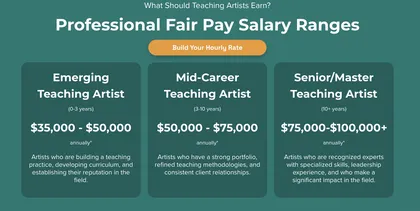
Rather than estimate an individual's wage, we wanted to establish professional standards that Teaching Artists could govern collectively.
The regional salary ranges came first.
The rate builder became one tool for implementing those standards. In other words, the tool supports the standard. It's not the other way around.
I like to think Teaching Artists applied something we already understand deeply: backward design.
In our teaching practice, we do not begin by choosing activities and hoping they lead somewhere meaningful. We begin by asking: What do we want learners to understand, experience, and be able to do? Then we build the structures that support that outcome.
TAMA approached professional infrastructure the same way.
We started with the question: What does a sustainable Teaching Artist profession need to look like?
Then we worked backward.
- What standards or principles are necessary?
- What compensation reflects those standards?
- What tools help artists and organizations implement them?
- What structures allow Teaching Artists to continually evaluate and evolve them?
The rate builder is not the destination. It is a tool in a larger process of professional self-governance.
The builder should be used annually by an artist to reflect on their practice and determine their rates. That process should happen in conversation with a community of Teaching Artists, where we challenge each other by asking:
- What does it cost to operate a Teaching Artist business in our region?
- What should experience, expertise, and continued growth be worth?
- What distinguishes emerging, professional, and advanced practice?
- How should rates respond to inflation and changing costs of living?
- How do other income streams, contracts, and business realities shape the compensation required for Teaching Artistry?
- How do we advocate for and negotiate these rates so that we are not competing to the bottom, but collectively raising the standards of the profession?
This is only the beginning. TAMA has more in the pipeline, and I'm excited about what's to come.
First and foremost, TAMA's contributing members will vote annually on the regional salary ranges and other professional standards that align with those standards. Rather than remaining static recommendations, TAMA has and is developing living standards that are shaped, debated, and revised by the professionals doing the work.
Mature professions don't simply provide tools and resources. They create mechanisms for accountability.
Doctors. Architects. Lawyers. Social Workers. Teachers.
Teaching Artists deserve the opportunity to do the same.
We have certain standards of practice and care, skills and competencies, and ethical responsibilities that we should follow, especially as the door to social prescribing widens.
Today, much of Teaching Artistry is still defined outside the profession itself. Training. Certification. Job descriptions. Pay guidance. Professional development. Membership.
None of these are neutral.
Every piece of infrastructure embeds values. The architects of that infrastructure influence who has power, what is valued, and how a profession evolves.
# Professional infrastructure should be created with Teaching Artists, governed by Teaching Artists, and accountable to Teaching Artists.
During the effort to have "Teaching Artist" recognized within the U.S. Department of Labor's Standard Occupational Classification system, one question surfaced in my mind: Who governs this profession?
The application wasn't only about describing Teaching Artist work. It also required demonstrating that Teaching Artists have professional organizations capable of representing and developing the occupation itself.
Professional infrastructure should be created with Teaching Artists, governed by Teaching Artists, and accountable to Teaching Artists.
TAMA didn't build a rate builder because the field needed another calculator.
We built it because professions mature when practitioners govern their own standards.
# TAMA didn't build a rate builder because the field needed another calculator. We built it because professions mature when practitioners govern their own standards.
Rates will evolve.
Standards will evolve.
Infrastructure will evolve.
Teaching Artists should be the ones shaping that evolution.
Read More
Beyond Membership
Building from Divide and Conquer: Why Teaching Artists Struggle to Mobilize Collectively, this essay explores what comes after recognizing fragmentation: building power. Through reflections on membership, labor organizing, and Teaching Artist-led infrastructure, it examines why connection alone is not enough to change systems. The work ahead is not creating new knowledge—it is creating the structures, resources, and shared power needed to act on what Teaching Artists already know.

Divide and Conquer, Part 2
In part 2, I further examine how fragmentation in Teaching Artistry is built into systems of pay, contracting, classification, and training. I argue that this requires structural clarity, shared standards, and enforceable systems that reflect the full scope of Teaching Artist labor.
Divide and Conquer: Why Teaching Artists Struggle to Mobilize Collectively
The field shapes Teaching Artists through structural fragmentation across geography, disciplines, employment systems, and institutional access. These overlapping systems produce uneven value, scarcity, and separation between “inside” and “outside” positions, limiting connection and hindering collective organizing. With collective commitment, Teaching Artists can move from fragmentation toward power.

The Hidden Labor of Teaching Artists
This piece exposes the full scope of Teaching Artist labor. Before, between, during, and after the visible moment of a session, and how most of it goes uncompensated. This invisibility is not accidental, but structural, with artists absorbing the cost of sustaining programs. The result is a system that depends on hidden labor while failing to fully recognize or resource the professionals doing the work.
Stop Training Teaching Artists. Start Paying Them.
Teaching Artists are often told the solution is more training. We are missing the real issues: a lack of compensation, trust, and power-sharing with artists. Teaching Artists know what the work demands, and when they have felt valued and supported in doing their best work.

Outside the Gate: A Story About Excellence in Teaching Artistry
This personal reflection traces my journey as a Teaching Artist working outside what is traditionally considered “respected” theatre. It asks a central question: if the work has always been excellent, why have our systems struggled to recognize, resource, and value it?
We Don’t Have a Training Problem. We Have a Pay Problem.
This follow-up builds on the growing conversation sparked by my recent post. It clarifies what’s at stake for Teaching Artists and lays the groundwork for a series of deeper explorations into fair pay, hidden labor, systemic barriers, and what it will take to move from dialogue to action.

Stop Rebuilding What Already Exists: Teaching Artists Are Leading the Field
The Teaching Artist field does not need to be rebuilt. It needs to be recognized and resourced. This piece exposes the cycle of extractive “listening,” highlights the work already being led by Teaching Artists, and calls for a shift in power, compensation, and accountability.